Introduction
Internet and networking technologies are evolving rapidly as businesses, consumers, cloud platforms, smart devices, and artificial intelligence systems demand faster and more reliable connectivity. In 2026, networking is no longer limited to connecting computers and smartphones. Modern networks are becoming intelligent infrastructure that supports cloud computing, AI applications, connected vehicles, smart homes, industrial systems, remote work, digital services, and real-time communication.
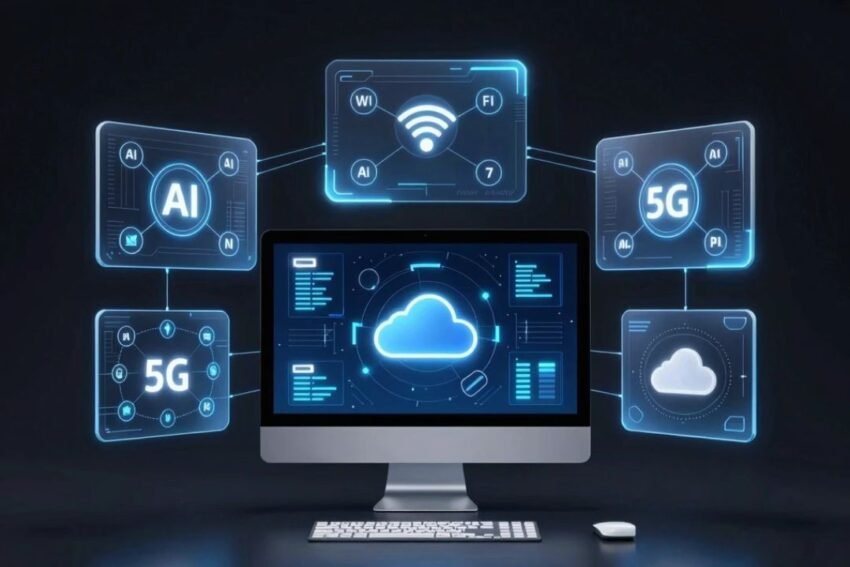
Several important technologies are shaping the future of connectivity. AI-powered networking, Wi-Fi 7, 5G, cloud networking, edge computing, Internet of Things (IoT), fiber-optic infrastructure, and emerging 6G research are changing how networks are designed and managed.
At the same time, cybersecurity has become a critical networking priority. As more devices and applications become connected, organizations need stronger identity controls, encryption, monitoring, and automated threat detection.
This guide explores the top Internet and Networking trends in 2026, their benefits, applications, challenges, and potential impact on businesses and everyday users.
1. AI-Powered Networking
Artificial intelligence is becoming an important part of modern network management.
Traditional network management often requires administrators to manually monitor traffic, identify problems, and configure devices.
AI can potentially automate parts of this process.
AI-powered networking can help with:
- Network monitoring
- Traffic analysis
- Anomaly detection
- Performance optimization
- Predictive maintenance
- Automated troubleshooting
- Security monitoring
For example, an AI-powered network-management system may identify unusual traffic patterns and alert administrators before they become major problems.
As networks become more complex, AI can help organizations manage large infrastructure more efficiently.
2. Wi-Fi 7 Adoption
Wi-Fi 7 is one of the major wireless networking developments of the current generation.
It is designed to provide higher throughput, lower latency, and better performance in demanding environments compared with previous Wi-Fi generations.
Important Wi-Fi 7 capabilities include:
- Wider channels
- Multi-Link Operation
- Higher modulation efficiency
- Improved network capacity
- Reduced latency
Wi-Fi 7 can be useful for high-bandwidth applications such as:
- 4K and 8K media
- Cloud gaming
- Virtual reality
- Video conferencing
- Large file transfers
- Smart-home systems
Actual performance depends on compatible devices, network configuration, spectrum conditions, and the internet connection.
3. 5G Network Expansion
5G continues to play an important role in mobile connectivity.
Compared with earlier generations, 5G can provide higher speeds, lower latency, and greater capacity in suitable deployments.
Potential applications include:
- Mobile broadband
- Smart cities
- Industrial IoT
- Connected vehicles
- Remote operations
- Cloud gaming
- Real-time communication
5G is also helping connect a growing number of devices outside traditional smartphone use.
4. 5G and Wi-Fi Working Together
The future of connectivity is not necessarily about choosing between cellular and Wi-Fi networks.
Instead, the two technologies can complement each other.
Wi-Fi is particularly useful for local connectivity in homes, offices, schools, and public spaces.
5G provides broader cellular coverage and mobility.
Businesses can use both technologies to create flexible connectivity environments.
For users, seamless movement between wireless technologies can improve access to digital services.
5. Cloud Networking
Cloud computing continues to transform networking architecture.
Businesses increasingly connect users, applications, databases, servers, and services through cloud infrastructure.
Cloud networking can provide:
- Scalability
- Flexible infrastructure
- Remote access
- Centralized management
- Software-defined networking
- Integration with cloud applications
Many organizations now operate hybrid environments that combine on-premises systems with public and private cloud infrastructure.
Networking is therefore becoming increasingly important to cloud strategy.
6. Edge Computing
Edge computing brings computing and data processing closer to the devices and locations where information is generated.
Instead of sending every piece of data to a distant data center, certain workloads can be processed closer to the user or device.
Potential benefits include:
- Lower latency
- Faster responses
- Reduced bandwidth requirements
- Improved local processing
- Better support for real-time applications
Edge computing can support:
- Smart factories
- Autonomous systems
- Connected vehicles
- IoT
- Retail systems
- Smart cities
Edge and cloud computing are increasingly being used together.
7. Internet of Things Growth
The Internet of Things continues to expand as more physical devices become connected.
Examples include:
- Smart appliances
- Wearable devices
- Security cameras
- Industrial sensors
- Smart lighting
- Connected vehicles
- Medical devices
These devices depend on reliable networking to communicate and exchange information.
As IoT grows, organizations will need better device management, network segmentation, authentication, and security.
8. Private 5G Networks
Private 5G networks are another important networking development.
A private cellular network can provide dedicated connectivity for a specific organization or location.
Potential applications include:
- Manufacturing
- Warehouses
- Ports
- Large campuses
- Industrial facilities
- Logistics
Private 5G can support large numbers of connected devices and applications that require reliable wireless connectivity.
Organizations must evaluate deployment costs, spectrum availability, device compatibility, and operational requirements.
9. Fiber-Optic Internet Expansion
Fiber-optic technology remains an important foundation of high-speed internet infrastructure.
Fiber can support large amounts of data over long distances and is widely used in:
- Broadband networks
- Data centers
- Cloud infrastructure
- Telecommunications
- Enterprise networks
As demand for high-bandwidth services grows, fiber infrastructure remains essential.
Streaming, cloud applications, AI workloads, video conferencing, and large data transfers all increase demand for reliable high-capacity connections.
10. 6G Research and Development
Although 5G remains an important current-generation technology, research into 6G is already underway.
Future wireless networks are expected to explore:
- Higher data rates
- Lower latency
- Greater network intelligence
- Advanced sensing
- AI integration
- New spectrum technologies
6G is still a developing area, so many details of future commercial deployments remain uncertain.
The technology could eventually support advanced applications involving immersive communication, robotics, sensing, and highly connected environments.
11. Software-Defined Networking
Software-defined networking (SDN) separates certain network-control functions from traditional hardware-based management.
This can make networks more programmable and easier to manage.
Potential benefits include:
- Centralized control
- Flexible configuration
- Automation
- Network visibility
- Easier policy management
SDN is particularly useful in large enterprise and data-center environments where administrators need to manage complex infrastructure.
12. Network Function Virtualization
Network Function Virtualization, often called NFV, allows certain networking functions to run as software rather than relying entirely on specialized hardware.
This can support services such as:
- Firewalls
- Routing
- Load balancing
- Security functions
- Network management
Virtualized networking can provide greater flexibility and may make infrastructure easier to scale.
13. Zero Trust Network Security
As networks become more distributed, traditional security models are changing.
Zero Trust is based on the principle that access should not automatically be trusted simply because a user or device is inside a particular network.
Important Zero Trust concepts include:
- Identity verification
- Least-privilege access
- Continuous monitoring
- Device verification
- Network segmentation
Zero Trust is particularly relevant to cloud environments, remote work, mobile devices, and distributed business systems.
14. Network Security Automation
Cybersecurity threats are becoming increasingly complex.
Organizations are therefore exploring automated network security.
AI and automation can potentially help with:
- Threat detection
- Suspicious traffic analysis
- Security alerts
- Access monitoring
- Incident investigation
- Automated responses
Automation can reduce response times, but security teams should carefully control automated actions to prevent incorrect decisions from causing disruption.
15. Network Slicing
Network slicing is a technology associated with advanced mobile networking.
It allows network infrastructure to support logically separated network environments for different applications or requirements.
For example, different services may require different levels of:
- Latency
- Reliability
- Capacity
- Security
Network slicing can help operators provide differentiated services over shared infrastructure.
It may become increasingly important as networks support a wider range of industrial and digital applications.
16. Satellite Internet
Satellite internet is expanding connectivity options, particularly in locations where traditional broadband infrastructure can be difficult to deploy.
Modern satellite systems can support:
- Remote communities
- Rural connectivity
- Transportation
- Emergency communications
- Backup internet connections
Satellite connectivity can complement fiber, cable, fixed wireless, and cellular networks.
Performance varies based on satellite technology, location, network capacity, and environmental conditions.
17. Low-Latency Networking
Low latency is becoming increasingly important as applications become more interactive.
Low-latency networking can benefit:
- Online gaming
- Video conferencing
- Financial applications
- Industrial automation
- Remote control
- Augmented reality
- Virtual reality
Reducing latency requires more than simply increasing internet speed.
Network architecture, routing, physical distance, congestion, and application design can all affect latency.
18. Networking for AI Workloads
Artificial intelligence is creating new demands for networking infrastructure.
AI systems can require large amounts of data to move between:
- GPUs
- Servers
- Storage systems
- Data centers
- Cloud platforms
High-performance networking is therefore becoming increasingly important for AI infrastructure.
Data centers are adopting advanced networking technologies to support large-scale AI workloads and distributed computing.
19. Data Center Networking
Data centers are becoming more important as cloud computing and AI expand.
Modern data-center networks must support:
- High bandwidth
- Low latency
- Scalability
- Redundancy
- Security
- Efficient data movement
AI workloads can create particularly demanding communication requirements between computing systems.
Network design is therefore becoming an important part of modern data-center architecture.
20. Network Observability
Network monitoring is evolving toward broader network observability.
Instead of simply checking whether a device is online, observability can provide deeper information about:
- Performance
- Traffic
- Latency
- Application behavior
- Errors
- Security events
Better visibility can help administrators identify the causes of network problems rather than simply detecting symptoms.
AI can potentially enhance observability by identifying unusual patterns in large amounts of network data.
21. Wi-Fi 7 for Smart Homes
Smart homes are becoming increasingly connected.
Households may use networks for:
- Smart TVs
- Cameras
- Speakers
- Appliances
- Gaming systems
- Smartphones
- Computers
- Security devices
Wi-Fi 7 can provide improved wireless capacity for homes with many connected devices when supported by compatible equipment.
However, users should also consider router placement, internet bandwidth, security settings, and device compatibility.
22. Networking for Connected Vehicles
Connected vehicles depend on multiple communication technologies.
These can include:
- Cellular networks
- Wi-Fi
- Bluetooth
- Vehicle-to-network communication
- Other wireless systems
Future transportation systems may increasingly use networking for navigation, diagnostics, entertainment, safety-related systems, and software updates.
Connected-vehicle networks require strong security because compromised systems could create significant risks.
23. Network Automation
Network automation reduces the need for manual configuration.
Automation can help organizations:
- Configure devices
- Apply policies
- Monitor performance
- Detect failures
- Deploy changes
- Generate reports
When combined with AI, automation can become more adaptive.
Organizations should use testing, access controls, logging, and approval processes when automating critical network operations.
24. Energy-Efficient Networking
As network infrastructure grows, energy efficiency is becoming increasingly important.
Data centers, telecommunications systems, routers, switches, and wireless equipment consume energy.
Organizations can improve efficiency through:
- More efficient hardware
- Better cooling
- Intelligent workload management
- Network optimization
- Improved data-center design
AI may also help identify opportunities to reduce unnecessary resource usage.
25. The Future of Internet Connectivity
The internet is becoming more distributed, intelligent, and connected.
Future connectivity may combine:
Fiber + Wi-Fi + 5G + Satellite + Edge Computing + Cloud + AI
Instead of relying on one technology, modern digital infrastructure will increasingly use multiple network types together.
This can provide greater flexibility and support different requirements for homes, businesses, industries, and public services.
Benefits of New Networking Technologies
The latest networking trends can provide several advantages.
Faster Connectivity
New technologies can increase data-transfer capacity.
Lower Latency
Advanced networks can support faster responses.
Better Reliability
Redundant and intelligent infrastructure can improve availability.
Greater Scalability
Cloud and software-defined technologies can make networks easier to expand.
Improved Security
Modern security approaches can provide stronger access controls and monitoring.
Better Automation
AI and software tools can reduce manual network-management tasks.
Challenges of Internet and Networking Trends
Despite rapid innovation, several challenges remain.
Cost
New infrastructure can require significant investment.
Security
More connected devices create more potential attack surfaces.
Complexity
Modern hybrid networks can be difficult to manage.
Compatibility
Older devices may not support newer networking standards.
Privacy
Connected systems can collect and transmit large amounts of information.
Skills
Organizations need professionals who understand networking, cloud computing, cybersecurity, and automation.
How Businesses Can Prepare for Networking Trends
Businesses can prepare by taking a gradual approach.
Evaluate Current Infrastructure
Identify outdated equipment and performance limitations.
Improve Security
Use strong authentication, segmentation, encryption, monitoring, and access controls.
Adopt Cloud Networking
Use cloud infrastructure where it provides genuine business benefits.
Explore AI Automation
Automate suitable network-management tasks while maintaining human oversight.
Prepare for IoT
Create policies for connected devices and network access.
Train Employees
Networking and cybersecurity skills should evolve alongside technology.
Conclusion
The top Internet & Networking trends in 2026 show how quickly connectivity is evolving. AI-powered networking, Wi-Fi 7, 5G, cloud networking, edge computing, IoT, fiber infrastructure, private 5G, software-defined networking, and network automation are transforming modern digital infrastructure.
AI is becoming particularly important because networks are generating enormous amounts of information that can be analyzed for performance, security, and optimization. At the same time, AI workloads themselves are increasing demand for high-performance networking in cloud platforms and data centers.
Wireless technologies are also advancing. Wi-Fi 7 is designed for high-capacity local connectivity, while 5G continues to support mobile and industrial applications. Research into 6G may eventually introduce another major generation of wireless connectivity.
Security will remain a central requirement. Zero Trust, network segmentation, identity management, encryption, monitoring, and security automation will become increasingly important as more devices and applications connect to digital networks.
Looking ahead, the internet will likely become more intelligent, distributed, automated, and integrated. AI, Wi-Fi 7, 5G, cloud computing, edge infrastructure, fiber, satellite connectivity, and emerging 6G technologies will all contribute to the next generation of networking.
For businesses and consumers, understanding these trends can help with better technology planning and more secure connectivity. The future of networking is not based on one technology—it is a combination of interconnected systems working together to deliver faster, smarter, and more reliable digital experiences.