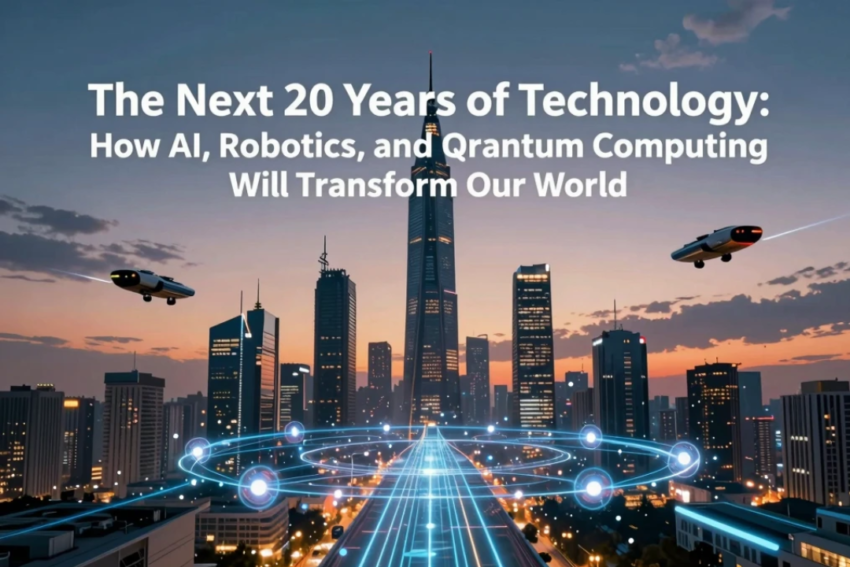
Technology has always shaped human civilization, from the invention of the wheel to the rise of the internet. However, the next twenty years promise to bring changes that may be more dramatic than anything humanity has experienced before. Rapid advances in artificial intelligence, robotics, and quantum computing are expected to transform industries, economies, and daily life. These technologies will not only improve efficiency and productivity but also redefine how people live, work, communicate, and solve global challenges.
In this article, we explore how these powerful technologies will shape the future and what they mean for the world in the coming decades.
The Rise of Artificial Intelligence
Artificial intelligence (AI) is already influencing many aspects of modern life. From voice assistants and recommendation systems to autonomous vehicles and medical diagnostics, AI is becoming an essential part of our digital ecosystem. Over the next two decades, AI will evolve from a supportive technology into a central decision-making tool across industries.
One of the biggest transformations will occur in healthcare. AI-powered systems will analyze vast amounts of medical data to detect diseases earlier and recommend personalized treatments. Doctors will use intelligent diagnostic tools that can identify patterns in medical images and genetic data much faster than humans. This could lead to earlier detection of conditions such as cancer, heart disease, and neurological disorders.
In education, AI will create personalized learning experiences. Instead of a one-size-fits-all system, students will learn through intelligent platforms that adapt to their pace, strengths, and weaknesses. This could improve learning outcomes and make education more accessible worldwide.
Businesses will also benefit significantly from AI-driven automation and data analysis. Companies will rely on intelligent algorithms to optimize supply chains, forecast market trends, and enhance customer experiences. As AI becomes more advanced, it will assist humans in creative and strategic tasks rather than simply performing repetitive work.
However, the growth of AI also raises important ethical and social questions. Issues such as data privacy, job displacement, and algorithmic bias will require careful regulation and responsible development.
Robotics and the Future of Work
Robotics technology is advancing rapidly, and robots are becoming more capable, intelligent, and affordable. In the next twenty years, robots will move beyond factories and enter everyday environments such as homes, hospitals, farms, and offices.
In manufacturing, robots will become more flexible and collaborative. Instead of replacing human workers entirely, many robots will work alongside humans, assisting with complex or dangerous tasks. These “collaborative robots,” or cobots, will increase productivity while improving workplace safety.
Healthcare is another sector where robotics will play a crucial role. Surgical robots will allow doctors to perform highly precise procedures with minimal invasiveness. Rehabilitation robots will help patients recover from injuries by guiding physical therapy exercises. Elderly care robots may also assist with daily activities, helping aging populations maintain independence.
Agriculture will also be transformed by robotics. Autonomous machines will plant seeds, monitor crop health, and harvest produce with remarkable efficiency. These technologies will help farmers increase productivity while reducing the use of water, fertilizers, and pesticides.
In homes, service robots could become common household helpers. From cleaning and cooking to managing smart home systems, robots may simplify everyday tasks and save time for families.
Despite these benefits, the rise of robotics may also change the nature of employment. Some jobs will disappear, particularly those involving repetitive manual tasks. However, new opportunities will emerge in areas such as robot maintenance, programming, and design.
Quantum Computing: A Technological Revolution
While AI and robotics are already impacting industries, quantum computing represents a more radical technological leap. Unlike traditional computers that process information in binary bits (0s and 1s), quantum computers use quantum bits, or qubits. These qubits can exist in multiple states simultaneously, allowing quantum computers to perform certain calculations exponentially faster than classical computers.
Over the next twenty years, quantum computing could revolutionize fields that rely on complex calculations. One of the most promising applications is drug discovery. Pharmaceutical companies will be able to simulate molecular interactions at an unprecedented level of accuracy, accelerating the development of new medicines and treatments.
Quantum computing will also play a significant role in climate research. Scientists will be able to create more accurate climate models and analyze large datasets to better understand environmental changes. This could help governments and organizations develop more effective strategies to combat climate change.
Another important application is cybersecurity. Quantum computers could potentially break many of today’s encryption methods, which protect online communications and financial transactions. However, researchers are also developing quantum-resistant encryption techniques to ensure digital security in the future.
Although quantum computing is still in its early stages, major technology companies and research institutions are investing heavily in its development. In the coming decades, breakthroughs in quantum hardware and algorithms could unlock entirely new possibilities.
Smart Cities and Connected Infrastructure
The integration of AI, robotics, and advanced computing will also lead to the development of smart cities. These cities will use connected technologies and sensors to improve transportation, energy efficiency, and public services.
Traffic systems powered by AI will reduce congestion by optimizing traffic signals and routing autonomous vehicles efficiently. Public transportation networks will become smarter and more responsive to real-time demand.
Energy systems will also become more sustainable. Smart grids will manage electricity distribution more efficiently, integrating renewable energy sources such as solar and wind power. AI will help balance energy demand and supply, reducing waste and lowering costs.
Urban infrastructure will be equipped with sensors that monitor air quality, water usage, and waste management. City administrators will use this data to make better decisions and improve residents’ quality of life.
Human–Machine Collaboration
One of the most significant aspects of future technology will be the collaboration between humans and intelligent machines. Rather than replacing humans entirely, many technologies will enhance human capabilities.
For example, augmented reality and brain-computer interfaces could allow people to interact with digital systems more naturally. Workers may use smart glasses to receive real-time information while performing tasks, increasing productivity and reducing errors.
In creative industries, AI tools will assist artists, writers, and designers in generating new ideas and exploring innovative concepts. This collaboration could lead to entirely new forms of art and entertainment.
Similarly, scientists and researchers will use AI and quantum computing to analyze complex data and solve problems that were previously impossible to tackle.
Challenges and Ethical Considerations
While the future of technology is exciting, it also presents challenges that society must address. Ethical considerations, data privacy, and responsible innovation will be critical in ensuring that technological progress benefits everyone.
Governments, companies, and researchers will need to work together to create policies that promote transparency and accountability in AI systems. Education and workforce training will also be essential to help people adapt to a rapidly changing job market.
Another important concern is the digital divide. Access to advanced technologies may not be evenly distributed across countries and communities. Efforts must be made to ensure that technological advancements do not increase inequality but instead help create opportunities for all.
Conclusion
The next twenty years will likely bring extraordinary technological progress. Artificial intelligence, robotics, and quantum computing will transform industries, reshape economies, and change how people interact with the world.
Healthcare will become more personalized and efficient, cities will become smarter and more sustainable, and scientific discoveries will accelerate at an unprecedented pace. At the same time, society will need to address ethical and social challenges to ensure that these technologies are used responsibly.
If managed wisely, the technological revolution ahead has the potential to improve living standards, solve global problems, and create a more connected and innovative world. The future of technology is not just about machines—it is about how humans and technology will work together to build a better future. 🚀