Introduction
Gaming is no longer just a pastime—it has become a global phenomenon, blending technology, entertainment, and social interaction. Over the past few decades, the industry has evolved from simple arcade games to sprawling open-world experiences and competitive esports. As we look ahead to 2035, the future of gaming promises to be even more revolutionary, driven by emerging technologies like artificial intelligence (AI), virtual reality (VR), augmented reality (AR), and cloud computing.
By 2035, gaming will no longer be confined to consoles or PCs. Instead, immersive digital worlds will be accessible anywhere, anytime, providing personalized experiences tailored to each player. These developments will not only redefine gameplay but also reshape how people socialize, learn, and even work within virtual environments. This article explores the transformative trends shaping gaming by 2035 and what players can expect from the next generation of interactive entertainment.
Artificial Intelligence: Smarter, Adaptive Gameplay
Artificial intelligence will be one of the most influential technologies shaping gaming in 2035. AI is already used to control non-player characters (NPCs) and manage game mechanics, but future AI will be far more sophisticated.
By 2035, AI could enable NPCs to learn and adapt dynamically to player behavior, creating gameplay that is truly unpredictable. Enemies could develop strategies based on previous encounters, while allies might respond intelligently to player decisions. This level of adaptability will make games feel alive and responsive, offering unique experiences for every player.
AI will also transform procedural content generation. Entire worlds, storylines, and missions could be automatically created based on a player’s choices, allowing for virtually limitless replayability. Personalized narratives and challenges will ensure that no two gaming experiences are ever the same.
Virtual Reality and Fully Immersive Worlds
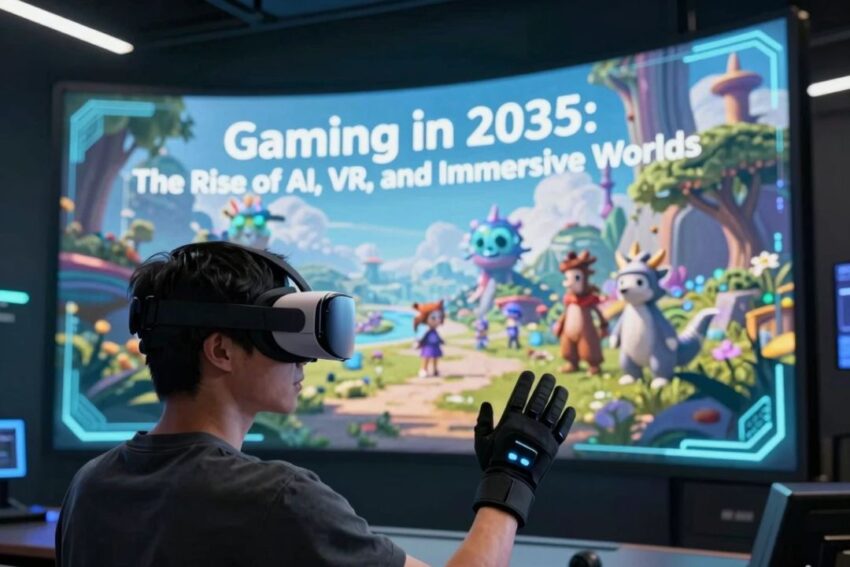
Virtual reality will continue to push the boundaries of immersion by 2035. Today’s VR technology allows players to experience digital worlds using headsets and motion controllers, but future systems will be significantly more advanced.
Next-generation VR headsets will feature ultra-high-resolution displays, full-body motion tracking, and realistic haptic feedback. Players could feel textures, temperature changes, and even physical forces within the game world, making experiences more lifelike than ever before.
These immersive VR worlds will not be limited to traditional game genres. Players might participate in virtual concerts, explore hyper-realistic historical reconstructions, or engage in full-scale virtual simulations that mimic real-life physics and environments. VR could also become a central platform for education and training, blending learning with interactive gameplay.
Augmented Reality: Gaming in the Real World
Augmented reality (AR) overlays digital content onto the physical world, creating interactive experiences that blend reality and virtual elements. AR gaming has already made waves with titles that encourage movement, exploration, and real-world problem-solving.
By 2035, AR technology will be far more sophisticated. Lightweight wearable devices or smart glasses could turn entire cities, neighborhoods, and homes into interactive game spaces. Players could participate in large-scale AR battles, collaborative quests, or city-wide scavenger hunts, interacting with both the environment and other players in real time.
AR gaming will also encourage physical activity and social engagement. Unlike traditional gaming, which is mostly sedentary, AR could integrate movement, teamwork, and exploration into entertainment, making it a healthier and more interactive form of gaming.
Cloud Gaming: Play Anywhere, Anytime
Cloud gaming will redefine accessibility and convenience in the future. In traditional gaming, players needed powerful consoles or PCs to run graphically intensive games. Cloud gaming removes this barrier by streaming games directly from servers, allowing high-quality experiences on virtually any device.
By 2035, cloud gaming infrastructure will be faster, more reliable, and globally widespread. Gamers will be able to switch seamlessly between devices—starting a game on a console, continuing on a smartphone, and finishing on a VR headset without losing progress. This flexibility will make gaming more accessible than ever and reduce the need for expensive hardware upgrades.
Additionally, cloud gaming could support massive multiplayer worlds that host millions of players simultaneously, creating persistent online universes that are always evolving.
Hyper-Realistic Graphics and Game Engines
Visual realism will reach unprecedented levels by 2035. Game engines will enable ultra-detailed environments, lifelike lighting, and physics that closely mimic the real world. Real-time ray tracing, advanced particle effects, and dynamic weather systems will make digital worlds indistinguishable from reality.
These graphical advancements will enhance immersion and storytelling. Players will experience games as living, breathing worlds, interacting with dynamic environments that respond to their actions. The combination of AI-driven behavior and realistic visuals will create fully believable virtual societies.
Esports and the Professional Gaming Ecosystem
By 2035, esports will be firmly established as a mainstream form of entertainment. Tournaments will attract global audiences, rivaling traditional sports in popularity and revenue. Professional players will enjoy careers with sponsorships, streaming opportunities, and virtual fan engagement.
Esports will also benefit from technological advancements. VR and AR tournaments may become commonplace, offering audiences fully immersive spectating experiences. AI-assisted coaching and analytics will help players refine strategies and optimize performance, raising the level of competitive play.
Social Gaming and Virtual Communities
Gaming in 2035 will be as much about social interaction as gameplay. Multiplayer experiences will evolve into expansive digital communities where players collaborate, compete, and socialize.
Virtual worlds will serve as meeting places for social events, concerts, and collaborative projects. Gamers will be able to create content, host virtual gatherings, and participate in shared storytelling experiences. These communities will blur the lines between gaming, social networking, and digital society.
Blockchain and Digital Ownership
Blockchain technology may play a larger role in gaming by 2035, enabling secure ownership of virtual items, characters, and currencies. Players could buy, sell, or trade digital assets across different games and platforms, creating interconnected virtual economies.
This digital ownership could also incentivize creativity and innovation. Players might earn income through in-game achievements or content creation, further integrating gaming into real-world economies.
Conclusion
The future of gaming in 2035 promises an unprecedented level of immersion, accessibility, and personalization. With artificial intelligence, virtual and augmented reality, cloud gaming, and advanced graphics, digital worlds will become more dynamic, realistic, and engaging than ever before.
Gaming will not only remain a form of entertainment but will also serve as a platform for social interaction, education, and professional opportunities. As technology continues to evolve, players will experience limitless possibilities, exploring vast worlds, connecting with global communities, and shaping their own unique experiences.
The next decade and beyond will redefine what it means to play, interact, and live within virtual worlds. The rise of AI, VR, and immersive technologies marks a new era for gaming—one where the boundaries between reality and digital experiences continue to blur.