Introduction
Web development is one of the most important areas of modern technology. Almost every business, organization, educational institution, online store, and digital service needs a website or web application to reach users and provide online services.
From simple personal websites to complex e-commerce platforms, banking systems, social networks, cloud applications, and enterprise software, web development provides the technologies needed to build and maintain digital experiences on the internet.
Modern web development involves much more than writing HTML and CSS. Developers use programming languages, frameworks, databases, APIs, cloud services, security technologies, content management systems, and artificial intelligence tools to create fast, interactive, and secure websites.
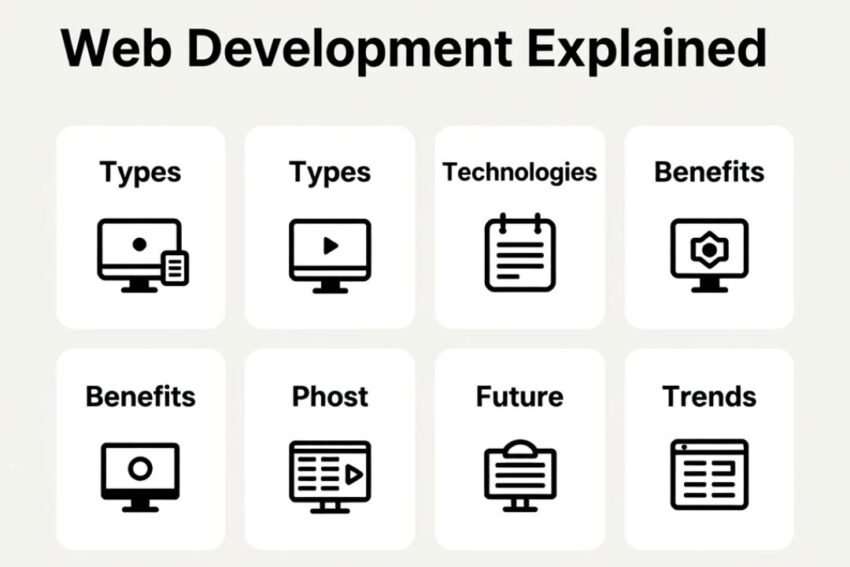
In this Web Development Explained guide, we will explore what web development is, its major types, important technologies, benefits, development process, security considerations, career opportunities, and future trends.
What Is Web Development?
Web development is the process of creating, building, testing, deploying, and maintaining websites and web applications.
It involves both the visible parts of a website that users interact with and the technical systems operating behind the scenes.
Web development can include:
- Website design implementation
- Frontend development
- Backend development
- Database management
- API development
- Web security
- Performance optimization
- Cloud deployment
- Website maintenance
A small website may require only basic HTML, CSS, and JavaScript, while a large web application may require multiple programming languages, databases, APIs, cloud infrastructure, and development teams.
How Does Web Development Work?
Web development usually involves several interconnected components.
When a user enters a website address into a browser, the browser communicates with a web server and requests the required resources.
The server may process the request, communicate with a database, and return information to the browser.
The browser then displays the website using technologies such as HTML, CSS, and JavaScript.
A simplified web development workflow looks like this:
User → Browser → Server → Application → Database → Server → Browser
Modern websites can also communicate with external APIs, cloud services, payment systems, analytics platforms, and other digital services.
Types of Web Development
Web development is generally divided into several major areas.
Frontend Development
Frontend development focuses on the parts of a website that users see and interact with.
Frontend developers work with technologies such as:
- HTML
- CSS
- JavaScript
- React
- Angular
- Vue
- TypeScript
Frontend development includes navigation menus, buttons, forms, animations, layouts, responsive design, and interactive components.
The goal is to create websites that are visually clear, functional, accessible, and responsive across different devices.
Backend Development
Backend development focuses on the server-side systems that power websites and web applications.
Backend developers may work with:
- Python
- JavaScript
- PHP
- Java
- C#
- Ruby
- Go
Backend systems can handle authentication, databases, business logic, APIs, payments, user accounts, and other application functions.
For example, when a user logs into an online store, the backend may verify the account credentials and retrieve the user’s information from a database.
Full-Stack Development
Full-stack development involves both frontend and backend development.
A full-stack developer may work on:
- User interfaces
- Server-side applications
- Databases
- APIs
- Authentication
- Deployment
- Performance
Full-stack development is useful for smaller teams because one developer can work across multiple parts of an application.
However, large organizations often have specialized frontend, backend, DevOps, security, and database professionals.
HTML, CSS and JavaScript
Three foundational technologies of web development are HTML, CSS, and JavaScript.
HTML
HTML, or HyperText Markup Language, provides the structure of a webpage.
It defines elements such as:
- Headings
- Paragraphs
- Images
- Links
- Forms
- Tables
- Sections
CSS
CSS, or Cascading Style Sheets, controls the visual presentation of webpages.
CSS can manage:
- Colors
- Fonts
- Spacing
- Layouts
- Animations
- Responsive designs
JavaScript
JavaScript adds functionality and interactivity to websites.
It can be used for:
- Interactive forms
- Menus
- Web applications
- Dynamic content
- Browser-based tools
- Animations
- API communication
Together, HTML, CSS, and JavaScript form the foundation of modern frontend development.
Web Development Frameworks
Frameworks and libraries help developers build applications more efficiently.
Popular frontend technologies include:
- React
- Angular
- Vue
- Next.js
Backend development also has many frameworks.
Examples include:
- Django
- Laravel
- Express
- Spring
- ASP.NET
Frameworks provide reusable structures and tools that can simplify development.
The right framework depends on project requirements, team skills, performance needs, and long-term maintenance considerations.
Databases in Web Development
Most modern web applications need databases to store information.
Databases can store:
- User accounts
- Products
- Orders
- Articles
- Customer information
- Application settings
- Transaction records
Common database technologies include:
- MySQL
- PostgreSQL
- MongoDB
- Microsoft SQL Server
- SQLite
Relational databases organize information into structured tables, while many NoSQL databases use different data models.
APIs and Web Development
An API, or Application Programming Interface, allows different software systems to communicate with each other.
Web applications frequently use APIs to connect with external services.
For example, a website may use APIs for:
- Payments
- Maps
- Weather information
- Authentication
- Social media
- Shipping
- AI services
APIs make it possible to combine different technologies into a single application.
Responsive Web Development
People access websites from many different devices.
These include:
- Smartphones
- Tablets
- Laptops
- Desktop computers
- Smart TVs
Responsive web development allows websites to adapt their layouts to different screen sizes.
A responsive website should provide a usable experience across devices without requiring separate websites for every screen type.
Responsive design is now an essential part of modern web development.
Web Development and Mobile Devices
Mobile users represent a significant portion of internet traffic.
Developers therefore need to consider mobile performance when creating websites.
Important mobile development considerations include:
- Fast loading
- Touch-friendly controls
- Responsive layouts
- Readable text
- Efficient images
- Simple navigation
- Low data usage
Mobile-first development can help developers prioritize essential functionality for smaller screens.
Web Development and Cloud Computing
Cloud computing has transformed how websites and applications are hosted.
Instead of relying entirely on physical servers, developers can deploy applications using cloud infrastructure.
Cloud platforms can provide:
- Computing resources
- Storage
- Databases
- Networking
- Security tools
- Monitoring
- Content delivery
Cloud infrastructure can also make it easier to scale applications when traffic increases.
Web Development Security
Security is a critical part of web development.
Websites can face threats such as:
- SQL injection
- Cross-site scripting
- Credential attacks
- Data breaches
- Broken authentication
- API vulnerabilities
- Malware
- Denial-of-service attacks
Developers should use secure coding practices and regularly update software dependencies.
Important security measures can include:
- HTTPS
- Strong authentication
- Secure passwords
- Input validation
- Access controls
- Encryption
- Security testing
- Regular updates
Security should be considered throughout the development lifecycle rather than added only after an application is completed.
Web Performance Optimization
Website performance affects user experience.
Slow websites can frustrate visitors and may negatively affect engagement.
Developers can improve performance through:
- Image optimization
- Code minification
- Browser caching
- Content delivery networks
- Efficient database queries
- Lazy loading
- Server optimization
- Reduced third-party scripts
Performance optimization becomes particularly important for large websites and applications with significant traffic.
Search Engine Optimization and Web Development
Web development and SEO are closely connected.
Technical web development decisions can influence how search engines understand and access a website.
Important technical SEO factors include:
- Mobile responsiveness
- Page speed
- Crawlability
- Structured data
- Clean URLs
- Internal linking
- Proper HTML structure
- Secure HTTPS connections
Developers and SEO professionals often need to work together to create websites that are both technically sound and search-friendly.
Content Management Systems
Not every website needs to be built completely from scratch.
Content management systems, or CMS platforms, allow users to create and manage websites without developing every feature manually.
CMS platforms can provide:
- Content editing
- Themes
- Plugins
- User management
- Media management
- Publishing tools
They are commonly used for blogs, business websites, news sites, online stores, and other content-driven websites.
E-Commerce Web Development
E-commerce websites require additional functionality compared with basic websites.
They may include:
- Product catalogs
- Shopping carts
- User accounts
- Payment systems
- Order management
- Inventory systems
- Shipping integration
- Customer support
Security is particularly important because e-commerce websites often process sensitive customer and payment information.
Artificial Intelligence in Web Development
Artificial intelligence is becoming increasingly important in web development.
AI tools can help developers with:
- Code generation
- Debugging
- Documentation
- Testing
- Code explanations
- Website content
- Design ideas
- Search functionality
AI coding assistants can accelerate development, but developers should still review generated code for security, correctness, maintainability, and performance.
AI may increasingly become a development partner rather than simply a code-generation tool.
Web Development Tools
Developers use many tools during the development process.
Common categories include:
- Code editors
- Version-control systems
- Testing frameworks
- Browser developer tools
- Package managers
- Design tools
- Database tools
- Deployment platforms
- Monitoring systems
Version control is particularly important for collaborative development because it allows teams to track changes and manage different versions of their code.
The Web Development Process
A typical web development project can follow several stages.
1. Planning
Developers identify the website’s purpose, target users, features, and technical requirements.
2. Design
The structure, layout, navigation, and user experience are planned.
3. Development
Frontend, backend, databases, and APIs are implemented.
4. Testing
Developers test functionality, performance, compatibility, accessibility, and security.
5. Deployment
The website or application is released to a production environment.
6. Maintenance
Developers monitor the application, fix problems, update dependencies, and introduce improvements.
This process may be iterative rather than strictly linear.
Benefits of Web Development
Professional web development provides several potential benefits.
Global Reach
A website can allow businesses and organizations to reach users across different locations.
24/7 Availability
Online services can remain accessible around the clock.
Business Growth
Websites can support marketing, sales, customer service, and digital products.
Automation
Web applications can automate repetitive tasks.
Better Customer Experience
Interactive websites can make it easier for customers to access information and services.
Scalability
Modern cloud infrastructure can allow applications to grow as demand increases.
Web Development Careers
Web development offers several career paths.
Professionals can specialize in:
- Frontend development
- Backend development
- Full-stack development
- UI development
- Web security
- DevOps
- Database development
- API development
- Cloud engineering
Important skills include programming, problem-solving, debugging, communication, version control, security awareness, and continuous learning.
Because web technologies change frequently, developers need to keep learning new tools and techniques.
Future Trends in Web Development
The future of web development is likely to be influenced by several technologies.
AI-Assisted Development
AI coding tools may increasingly assist developers with software creation, testing, debugging, and documentation.
Progressive Web Applications
Progressive Web Applications can combine web technologies with features commonly associated with native applications.
WebAssembly
WebAssembly can allow high-performance code to run in web browsers and may expand the types of applications that can run on the web.
Edge Computing
Edge computing can move application processing closer to users, potentially reducing latency.
Web3
Blockchain-based technologies may continue to influence certain areas of digital ownership, payments, and decentralized applications.
Voice and Multimodal Interfaces
Websites may increasingly support voice, image, and other natural interaction methods.
Advanced Web Security
As threats become more sophisticated, secure authentication, privacy technologies, and automated security monitoring will become increasingly important.
Conclusion
Web development is a fundamental part of the modern digital economy. It combines programming, design, databases, APIs, cloud infrastructure, security, and many other technologies to create websites and web applications.
Frontend development focuses on the user experience, while backend development manages server-side functionality and data. Full-stack development combines both areas.
Technologies such as HTML, CSS, JavaScript, modern frameworks, databases, APIs, cloud computing, and AI tools continue to shape the web development ecosystem.
The future of web development is likely to involve more AI-assisted coding, cloud-native applications, edge computing, advanced security, progressive web applications, and increasingly interactive digital experiences.
For businesses, a well-developed website can provide global reach, customer engagement, automation, and digital growth. For developers, web development remains a valuable technology field with many opportunities for specialization.
As the internet continues to evolve, web development will remain essential for building the websites, applications, and digital services that people use every day.
The future of web development is becoming more intelligent, connected, secure, and automated—and developers who continue learning modern technologies will be better prepared for the next generation of the web.